
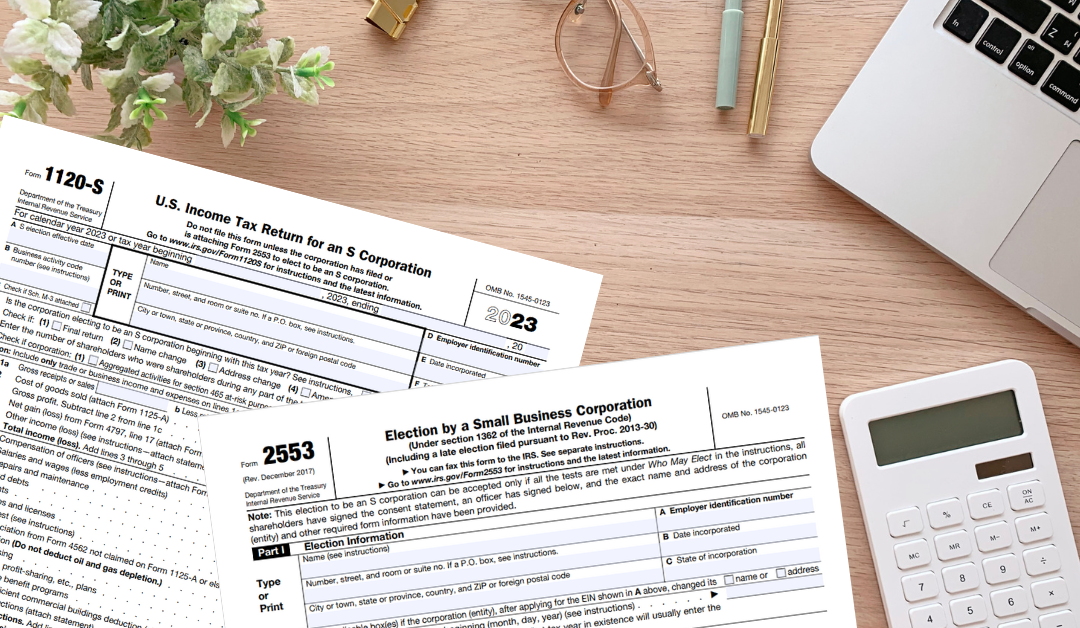
I’ve been hearing this question a lot so I thought I’d answer it for you here in the EFG Blog. If you’ve been wondering, hearing, or even seeing advertisements about turning your LLC into a S-Corporation because it can save you thousands in taxes, take a moment to pause and really do your research. This is a big decision for your business and the answer to the question, “should I turn my LLC into a S-Corp?” is not always a straightforward one.
Let’s start with some basic facts before we dive into specifics. An LLC is a Limited Liability Company with one or more members. An LLC is not a type of tax structure, it can be taxed as sole proprietorship/ disregarded entity, a partnership, or an s-corporation. Each of these have different tax forms, structures, and rules. Typically, in the online space, when discussing switching to an S-Corp, we’re talking about an LLC that is 100% owned by one person and currently being taxed as a disregarded entity on Schedule C of a 1040 Tax Return.
While the tax savings and other benefits of an S-Corp are great, this move may not be for everyone. Recently, I have worked with several online business owners who were either told to switch or did make the switch to be treated as an S-Corp. After review of their business and tax returns their gut feelings were confirmed, they should have stayed an LLC being taxed as a disregarded entity. I’d like to make it clear that filing the paperwork to be an S-Corp alone will not save you money in taxes. The tax savings are a result of what you choose to pay yourself, how well you manage your business money throughout the year, and how you adhere to the IRS’s boundaries.
Here’s what you need to know before you decide to elect to be taxed as an S-Corporation:
S-Corporations are required to pay the owners a reasonable compensation for the work they perform in the business. This is going to be the biggest change in terms of how you manage your business money and day-to-day tasks.
- The business pays you, the owner, like an employee. This means you’ll have a W2 at the end of the year.
- On your W2 federal income tax (FIT) social security and medicare taxes (FICA) will be withheld from your paycheck. Employer FICA taxes will need to be paid by the company too, this and the gross wages are deducted on the business tax return.
- You’ll need to find software to run payroll through. Gusto and QuickBooks are good options, be sure to have an accountant help you set this up. You’ll also have to choose how frequently you’ll be paying yourself – weekly, bi-weekly, or monthly are good options.
- The company will need to file quarterly payroll taxes on form 941, this should be done by an accountant.
- The company will have to comply with state employment regulations and most likely pay state unemployment tax, as well as federal unemployment tax (FUTA).
- Your salary amount can vary but should be comparable to similar positions in your industry and physical area.
- It is important to document your research that led to your determination of the salary, this may be needed in case of an IRS audit. You can find wage data HERE at the Bureau of Labor Statistics.
- Some states may require businesses operating as corporations to carry certain types of insurance.
I’d like to note that you will often see “if you make $40,000 in net income with your LLC, switching to an S-Corporation can save you money in taxes.” You may be wondering, how and why this number? Not all experts agree on the level of income needed to switch to an S-Corp.
The thought behind this statement is: if there is $40,000 in net income, there is $40,000 you can pay yourself as a salary – this is not good logic for several reasons.
First, $40,000 is barely a livable wage for the middle class in 2023 if you are working 40 hours in your business. You’d be bringing home less than $3,000 a month to pay for personal and cost of living expenses. According to Prosperity for America, the average income per person in 2023 was $69,717 and the state with the lowest average was Arkansas with $40,736. Do you know any CEO or high-level manager of a company working full time that takes a $40,000 salary? Probably not, so why should you take that salary when you’re in charge of a business and doing the same duties as a CEO or manager? Depending on your job duties, skills, and business’s industry, a $40,000 salary could be appropriate! But more times than not $40,000 is going to be low and we certainly don’t want the IRS to think you’re purposely paying yourself a low wage to avoid taxes.
Secondly, there are additional costs to the $40,000 salary. While employee FICA taxes (7.65%) are taken from this amount, employer FICA taxes (7.65%) are not. FICA taxes will be an additional $3,060 that the company owes. At this level, if you are the only employee in the business, there is also a FUTA tax requirement of $420 per year. If you’re a single member LLC using spreadsheets, combing through your personal bank account once a year for business expenses or do your own bookkeeping – that’s going to need to change. You’ll need formal accounting software with a bookkeeper as well as payroll software upgrades in QuickBooks or use Gusto separately. The software and accountant fees for bookkeeping, payroll, and payroll tax filing can easily be several hundred to a few thousand dollars of additional expenses. These should be factored into your decision and estimated calculations. Why spend a couple thousand to save a couple thousand at the end of the year? If you’re going to be an S-Corp you’d want to come out ahead, with more money in your pocket, not have a wash! Now let’s assume you have the full $40,000 profit in the bank, the easiest way to afford these additional and necessary expenses is to lower your salary even more!
Okay, now let’s do some math.
While writing this blog I got curious – what is the REAL difference between an S-Corp and LLC Schedule C in 2023 at $40,000 net profit? Instead of doing some basic calculation, (you may have even seen these on advertisements) I’m going to give you the real numbers as I’ve completely prepared two tax returns as a single person in 2023 making $40,000 in business income.
- Schedule C with $40,000 of Net Income yields Self-Employment Tax (15.3%) of $5,652 and Federal Income Tax of $2,019 > TOTAL taxes paid out to the government during the year are $7,671.
- S-Corporation paying yourself $36,520 (remember cash is still needed to pay the taxes on the business side, so you can’t pay yourself the full $40,000) this will actually yield $266 in business income. FICA taxes for both the business and employee (7.65% each) are $2,794, totaling $5,588, FUTA tax of $420, and Federal Income Tax of $2,526 > TOTAL taxes paid to the government during the year are $8,534.
WOAH, I bet you weren’t expecting that. I sure wasn’t! I actually thought the S-Corp would have a little extra savings by a couple hundred dollars; not that you would be paying MORE in taxes as an S-Corp by $863 at this income level. Here is the kicker though, with an S-Corp you’d be paying these taxes as you go, through payroll, and at the end of the year you probably wouldn’t owe anything. The same can be true for a Schedule C if you pay Quarterly Estimates to the IRS. However, if you wait until the end of the year, you’ll pay the $7,671 in full and have a penalty attached for not paying estimates.
Now before you go trying to recreate the math, just know that there are different calculations, rules and considerations within the IRS code and worksheets that lead to these numbers. Some of them include, the self-employment tax deduction and qualified business income deduction, both of which reduce the federal income tax calculation. If we want to get even more specific on what contributed to the $863 difference, $420 of it is FUTA tax, $507 is Federal Income Tax, and $64 is S-Corp savings within FICA/ SE Tax. All in all, in this example as a single self-employed person making $40,000 in profit, a whopping 20% is being handed over to the government. This is why I recommend 20% be saved for taxes or paid as estimates each quarter, this is a good rule of thumb for sole proprietors.
Depending on your business, $40,000 salary may be considered reasonable but as you can see, when net income is just on the cusp and only able to cover a salary, the tax savings aren’t really savings, or they are minimal. This is why I recommend having a net profit that can cover your reasonable salary plus $15,000 to $20,000 for unexpected or new expenses, money to reinvest in the business and owner distributions. One of the tax benefits for S-Corps is that the left-over net income and cash (after the salary is considered) can be distributed to the owner(s) TAX FREE. But in this S-Corp example, you’d be left with basically $0 in your business account and would not see any of that tax free money! You’d be missing out on one of the best S-Corp election advantages – and that’s the whole reason for switching to an S-Corp, to take advantage of the tax code to save money legally!
Let’s do another example, in this one you’ll be able to see how powerful the S-Corp election can be for the right business owner. This is a single person in 2023 making $80,000 profit before a salary (remember profit is revenue minus business expenses). We’re going to assume $55,000 is a reasonable salary for their job duties as a sole proprietor in their respective industry.
- Schedule C with $80,000 Net Income yields Self-Employment Tax (15.3%) of $11,304 and Federal Income Tax of $5,955 > TOTAL taxes paid out to the government during the year are $17,259.
- S-Corporation paying salary of $55,000 will actually yield $20,372 in business income. FICA taxes for both the business and employee (7.65% each) are $4,208, totaling $8,416, FUTA tax of $420, and Federal Income Tax of $7,946 > TOTAL taxes paid to the government during the year are $16,782.
Now I know $477 overall saved doesn’t seem like a lot but what most people will focus on are the savings on Social Security and Medicare tax (that’s what makes up FICA or Self-Employment tax if Schedule C) In this example the savings are $2,888 in total. Overall, when electing an S-Corp $25,000 of the $80,000 profit will not be subject to this tax. The more profit you make, the greater the Social Security and Medicare tax savings will be!
There’s more to think about than salary…
When pondering if you should switch to an S-Corp, what you pay yourself is only one piece of the puzzle. S-Corps are best for businesses and people who are in it for the long game. You should be reflecting on how stable your business has been leading up to this point.
- Do you have a long-term vision and goals for your company?
- What is your cashflow like?
- Are you always changing your streams of income or are they steady?
- Is your profit predictable?
- Can your company run on its own if something were to happen to you?
- Will there be other owners and investors of the S-Corporation?
I’ve mentioned I reviewed previous tax returns for new clients who had switched to an S-Corp, in one of these situations a client had one really great year in the online space and was told to switch to an S-Corp. But this client never had a conversation with their tax preparer about the true health of their company and their vision for their company. One year later, income streams changed, visions shifted, and the business was more or so put on hold while other life matters took precedence. A S-Corp just didn’t make sense and the client wanted a simpler tax season going forward.
I’d also like to note here that S-Corps are more difficult to set up and dissolve than LLCs. Once you choose to not be an S-Corp anymore you must wait 5 years before you can re-elect S-Corp status without IRS consent or difficulty. Generally, the clients I work with are sole proprietors who wholly own their business, but there are a few that are in partnerships or multi-member LLCs. Every owner must give consent to be taxed as an S-Corp but only more than 50% of ownership is needed to dissolve the S-Corp. If you have a company with 50/50 partners and they don’t agree when setting up or dissolving the S-Corp, you’re at a stalemate, which can cause friction, frustration, and loss of money in your business.
The truth is, everyone’s business and tax situation will be different.
There is no easy answer like, “did you make more than $40,000 this year?” that will determine if you should elect to be taxed as an S-Corp. More and more I see CPAs and national companies advertising and pressuring clients to switch to an S-Corp without the business owner even knowing the requirements and consequences other than “it will save money in taxes.” Usually, these professionals don’t give you the full picture, they are only focusing on your personal tax owed on the 1040 and disregard your company’s cash flow and personal goals (whether that be company goals or retirement considerations.) Unfortunately, I’ve also seen professionals claiming to save clients a few thousand dollars, but then they turn around and charge you a few thousand for advisement, filing, and tax preparation. So be cautious of who you work with and understand exactly what they are trying to sell to you.
It’s always best to get professional help and a full projected analysis of your tax situation before deciding to be taxed as an S-Corp. At The Entrepreneur’s Financial Group, we offer this full service and will give you a holistic overview and next steps to you need to take to make the best decision for your small business. If you are already an S-Corp and questioning if this tax structure is still best for you, we can review your last tax return too!
Book a call HERE with Olivia to get your unique analysis.